What Would Be Possible if You Knew You Had More Rights Than You Think?

When you imagine your future in the United States, what do you see? A home of your own? A business registered in your name? Your children growing up without that constant anxiety about what tomorrow might bring?
Now a second question, harder than the first: what stands between you and that future?
For most people, the answer isn't a lack of effort. It isn't a lack of talent. It isn't even a lack of will. It's one thing only: not knowing what's possible. And that gap in knowledge is the quietest, most expensive enemy anyone trying to immigrate will ever face.
Table of Contents
When the Country You Built No Longer Answers Your Questions

Think of someone like Camila. This is a hypothetical situation, but one that many people will recognize. She lives in Argentina, she's 34 years old, and she built her entire career through hard work. But in the last few years, something shifted. Her salary stopped keeping up with the cost of living. Uncertainty kept growing. The plans she had made for her children feel further away with every passing month. And every week, someone she knows announces they're leaving, or that they already left and have no plans to come back.
Camila isn't abandoning Argentina on impulse. She just wants to know if a real path exists toward a better life in the United States. But every time she searches, she finds contradictory information, processes that seem impossible, and a growing sense that this was all designed for other people, not for her.
What Camila doesn't yet know is that there are far more ways to immigrate legally to the U.S. than any Google search will ever show. Every situation has its own details. Different backgrounds open different doors. The problem isn't a lack of paths. The problem is that very few people talk about this clearly, and those who don't know what to ask rarely discover what's actually available to them.
This landscape was explored in depth in an article published here on the blog: Immigration to the U.S. in 2026: Trends and Opportunities.
When Working Hard Isn't Enough to Feel Safe
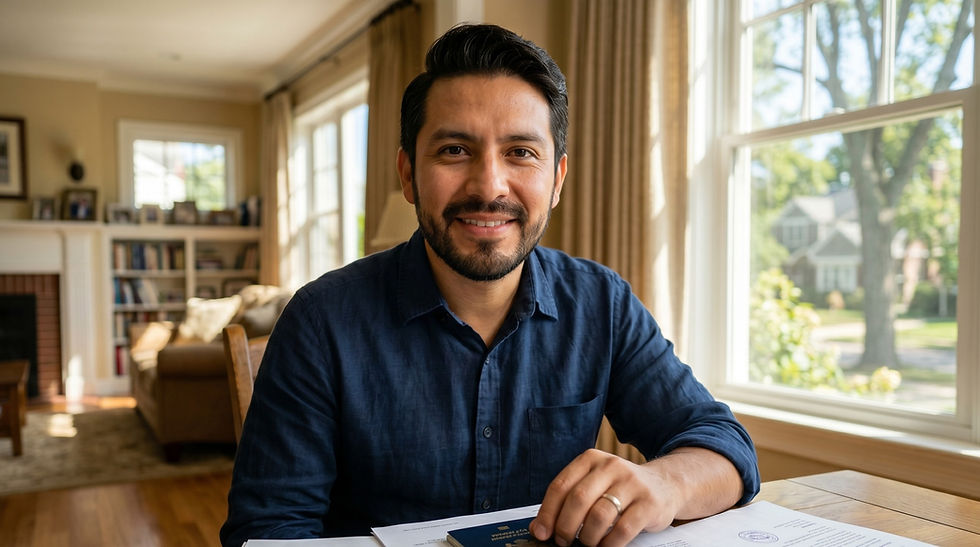
Now think of someone like Rafael. Also a hypothetical situation, but one that has been lived by many people. Rafael had been in Orlando for three years without legal status. He woke up early, worked hard, sent money home to his family. From the outside, things looked fine.
On the inside, it was a different story.
Every time he spotted a police car, his stomach turned. Every time his boss raised his voice, he kept his head down, because he had no ground to stand on. He couldn't buy a car in his own name. Opening a bank account wasn't straightforward. He couldn't plan anything beyond the following week.
What Rafael didn't know, and what changed everything once he found out, is that there are far more ways to regularize your status in the United States than most people realize. The problem isn't a lack of options. The problem is that very few people talk about it clearly. And when no one tells you what's possible, you end up assuming there's no way out.
The Green Card Changes What You Can Build, Not Just What You Can Do
When someone explains the rights of a permanent resident in the U.S., the temptation is to list bullet points: you can work, you can buy property, you can enroll your children in public school. All of that is true and it matters.
But no list captures what changes on the inside.
With a Green Card, you stop living in survival mode and start living in building mode. You can work for any employer, in any state, in any field, without needing sponsorship. You can buy and finance a home in your own name and start building real wealth. You can bring your spouse and children to live with you. And in time, once the requirements are met, you can apply for American citizenship.
But above all of that, you can make real plans. Plans with dates, with commitments, with the certainty that the ground beneath your feet is solid.
There's an enormous difference between the person who changes jobs because they found something better and the one who endures anything because they have no choice. Between the child who goes to school knowing they'll finish the year there and the one who carries uncertainty in their backpack every single morning. The Green Card doesn't fix everything, but it gives back something that undocumented life takes away: the ability to picture the future with confidence.
For anyone who wants to understand how the American job market works in practice, this article is worth reading: US Job Market Trends in 2026.
The Danger of Shortcuts on a Road That Has None
Something needs to be said honestly about what happens far too often.
Precisely because the knowledge gap is so wide, and the need is so urgent, many people end up in the hands of those who present themselves as solutions but have no legal authority to guide anyone through an immigration process. Notaries, informal consultants, fixers who promise fast and guaranteed results, take payment upfront, and then either disappear or deliver a flawed process that seriously damages the real chances of the people who trusted them.
In the U.S., only licensed attorneys and properly accredited representatives can offer legal guidance on immigration matters. That isn't bureaucracy. It's the difference between a process handled securely and a form filled out incorrectly that delays everything by months or leads to a denial.
The real consequences of getting this wrong were discussed in detail in the article What the U.S. Visa Suspension Really Means for Those Who Dream of a Green Card.
The path to a Green Card exists. But it has to be walked the right way.
What You Can Learn Today
When Rafael finally understood what options were available for his specific situation and found the right legal guidance, the process that had seemed impossible became real. He registered a business in Orlando. He's financing a home. His oldest son started college.
Not because luck came knocking. But because he stopped fighting his own ignorance alone.
That same possibility is available to you. Whether you're Camila, still in Argentina, trying to figure out if a real path exists. Whether you're Rafael, already here, ready to finally step out of the shadows. Or whether you're someone who tried before and got denied, someone who's been waiting for the right moment that never seems to come. One of the least known and most accessible routes for professionally qualified immigrants was explained in detail in the article about the EB2-NIW, and it's worth reading to see if that path fits your case.
The biggest step isn't the process itself. It's the decision to truly understand what's possible for you.
Murtaz Law: Where Every Case Is Treated as Unique

Murtaz Law is an American immigration law firm where every case is examined with close attention to the specifics of the person being helped. No process is treated as just another number.
The firm was built to be the place where the right questions are asked before any answers are given. Where each person's background is heard carefully, the available options are explained clearly, and the safest path is mapped out for each specific situation. Whether you're planning your immigration from scratch, need to regularize an undocumented situation, or had a previous petition denied, Murtaz Law has the legal support to help you do this the right way.
The team has accumulated over a decade of experience in American immigration law. Complex cases have been resolved. Processes that seemed like dead ends were turned into approvals. And every victory was celebrated as if it were the first, because behind every case there is a family, a dream, and years of effort that deserve to be treated with care.
Reach out and schedule a conversation. Because the future you're imagining may be much closer than the unknown has led you to believe.
Comments